Weighted Blankets: An Expensive Hug, or Real Medicine?
Weighted blankets have been around since the 1970s, originally used in occupational therapy for autistic people and adults with sensory processing needs. In the last few years they became a mainstream wellness product, marketed to anyone who's ever struggled to fall asleep or unwind. The science hasn't kept pace with the marketing budget — but it isn't nothing, either. Here's what clinical research actually supports, and who's most likely to notice a real difference.
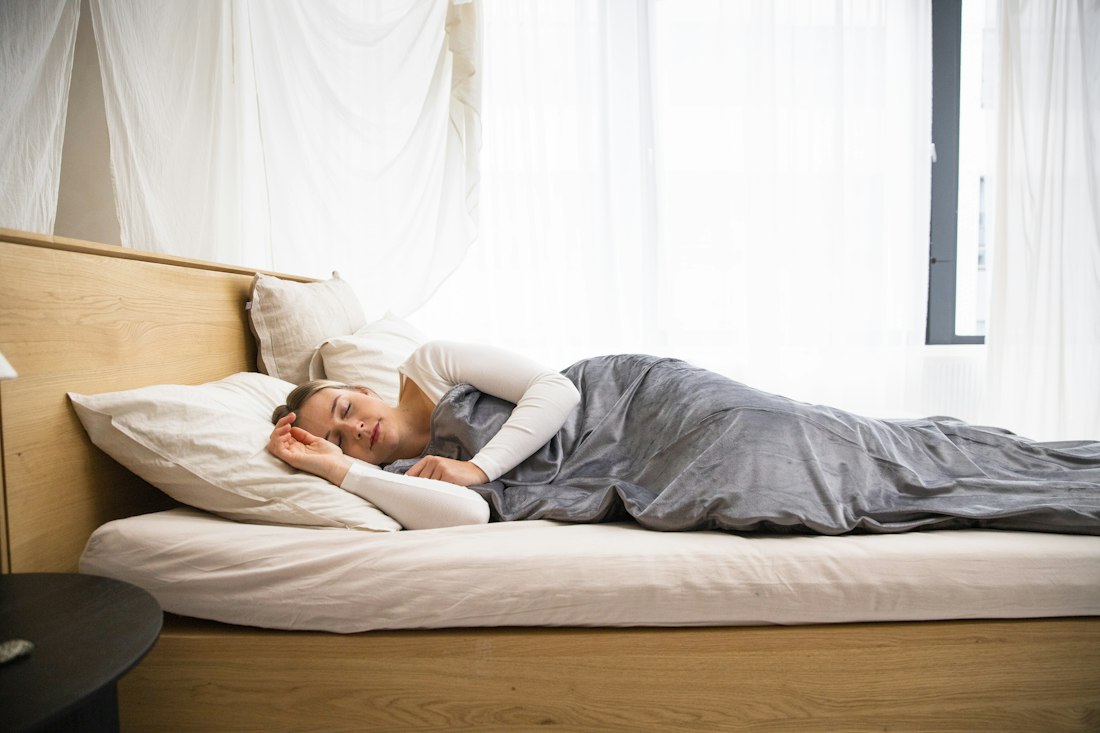
Weighted blankets are designed to mimic deep pressure touch, a sensation researchers have linked to changes in stress hormones in small studies.
What Deep Pressure Touch Is Actually Supposed to Do
Weighted blankets work on a principle called deep pressure therapy, or deep touch pressure — the same broad idea behind swaddling infants or a firm, reassuring hug. The theory is that evenly distributed pressure across the body can help regulate the nervous system, shifting it away from a stressed, hyperaroused state. Occupational therapists have used this approach since the 1970s to help autistic people and those with sensory processing disorders self-manage distress, well before it became a mass-market sleep product.
There's some direct physiological evidence behind the mechanism, not just the theory. A study of 26 young, healthy adults found that using a weighted blanket at bedtime (roughly 12% of body weight) resulted in higher pre-sleep salivary concentrations of both melatonin and oxytocin compared to a lighter blanket — hormones associated with sleep onset and calm, bonded states, respectively. That's a real, measured biological effect, even if it's from a small study.
Anxiety in Clinical Populations, Not Casual Users

Most of the strongest weighted blanket research comes from psychiatric inpatient and outpatient settings, not from studies of the general population.
The clearest, most consistent research findings are in anxiety reduction for people with diagnosed mental health conditions. A systematic review and meta-analysis of randomized controlled trials in patients with mental disorders concluded that weighted blankets have a small but positive effect on reducing anxiety, and might also help with insomnia in that population. In supporting studies, 63% of adults reported lower anxiety after just five minutes under a weighted blanket, and a study of psychiatric inpatients found 60% experienced reduced anxiety during their hospital stay.
This is exactly where the science and the marketing start to diverge. As one 2026 review published via The Conversation put it plainly: benefits for healthy people, without a diagnosed anxiety or sleep disorder, are much harder to prove, and roughly half the existing research doesn't meet quality standards robust enough to support the confident claims found on product packaging. That doesn't make weighted blankets useless for the general population — it means the evidence for casual, healthy users is thinner than the evidence for clinical populations, and the two shouldn't be conflated.
Sleep Benefits Are Less Consistent Than Anxiety Benefits
- Short-term anxiety reduction in people with diagnosed anxiety or mood disorders
- A measurable rise in pre-sleep melatonin and oxytocin in healthy adults using a weighted blanket
- General safety for most healthy adults at appropriate weights
- Insomnia and sleep quality improvements — some reviews find benefit, others call the evidence scarce and inconsistent
- Any benefit for healthy adults without a diagnosed condition — evidence is thin
- Use in autistic children specifically — the American Academy of Neurology found no evidence of improved sleep, though no reported danger either
- Long-term outcomes — most trials run only days to weeks, some up to a year, but long-term data is limited
A scoping review covering 38 studies found the research field itself has a consistency problem: outcome measures for sleep and anxiety are diverse and not standardized across studies, which makes it hard to directly compare results or draw firm conclusions. That's a methodological issue as much as a "does it work" issue — it's part of why reviewers keep calling for more rigorous, standardized trials rather than declaring the question settled either way.
Worth Buying, or Skip It?
Reasonable to try, especially for anxiety — just calibrate your expectations for sleep.
If you're managing diagnosed anxiety, the evidence for at least a modest calming effect is genuinely there, and a weighted blanket is a low-risk, non-pharmacological option worth discussing with a provider. If your main goal is better sleep as a healthy adult without a diagnosed condition, the evidence is thinner and more mixed than the five-star reviews suggest — it might help, partly through the same comfort and routine effect as any cozy bedtime ritual, but it isn't a proven insomnia treatment. Either way, it's a low-risk product: pick roughly 10% of your body weight and see how you respond.
Frequently Asked Questions
Do weighted blankets actually reduce anxiety?
For people with diagnosed anxiety or other mental health conditions, several studies show a real, if modest, effect. One trial found 63% of adults reported lower anxiety after just five minutes under a weighted blanket, and a study of psychiatric inpatients found 60% experienced reduced anxiety during their hospital stay. For people without a diagnosed condition, the evidence is much thinner.
Do weighted blankets help you sleep better?
The evidence for sleep is weaker and less consistent than the evidence for anxiety. Some systematic reviews report improvements in insomnia, total sleep time, and sleep onset latency, but reviewers note that about half the existing research doesn't meet strong quality standards, and results are more mixed than the marketing suggests.
Are weighted blankets safe for everyone?
For most healthy adults, yes, though a common guideline is choosing a blanket around 10% of body weight. They are not recommended for young children without medical guidance, due to suffocation risk, and the American Academy of Neurology found no evidence they improve sleep in autistic children specifically, while noting they haven't been reported as dangerous for that group.
More Health Guides, Written Clearly
Browse our full library of health explainers, updated as new research comes in.
More from the creator
Explore two other projects from the same creator.