How AI Is Being Used in Drug Discovery
Discovering a new drug has traditionally meant over a decade of work and roughly $2.6 billion in cost, with most candidates failing along the way. AI is now embedded at nearly every stage of that pipeline, from predicting how a protein folds to designing the molecule meant to bind it. This guide covers how that actually works, using the clearest public example, Isomorphic Labs and AlphaFold, as the throughline.

AlphaFold's breakthrough was predicting how proteins fold into their 3D shapes, the shape that determines how a drug can bind them.
What Problem Is AI Actually Solving in Drug Discovery?
Drug discovery is fundamentally a search problem across an almost incomprehensibly large space. Isomorphic Labs' chief AI officer, Max Jaderberg, describes the potential chemical space of drug-like molecules as at least 10^40, a number so vast that even the best traditional laboratory methods, testing molecules one by one or in batches, can only examine a vanishingly small fraction of it. AI's core contribution is narrowing that impossibly large space down to a shortlist worth actually synthesizing and testing in a lab.
The breakthrough that made this newly tractable was AlphaFold, Google DeepMind's protein structure prediction system. Proteins are the molecular machines a drug typically has to interact with, and knowing their precise 3D shape is essential to designing something that binds them correctly. AlphaFold 2 solved this decades-old structural biology problem in 2020, and DeepMind and Isomorphic Labs' 2024 follow-up, AlphaFold 3, expanded it to predict the joint structures and interactions of proteins, DNA, RNA, and small-molecule drugs together.
What Does Isomorphic Labs Actually Do With This Technology?
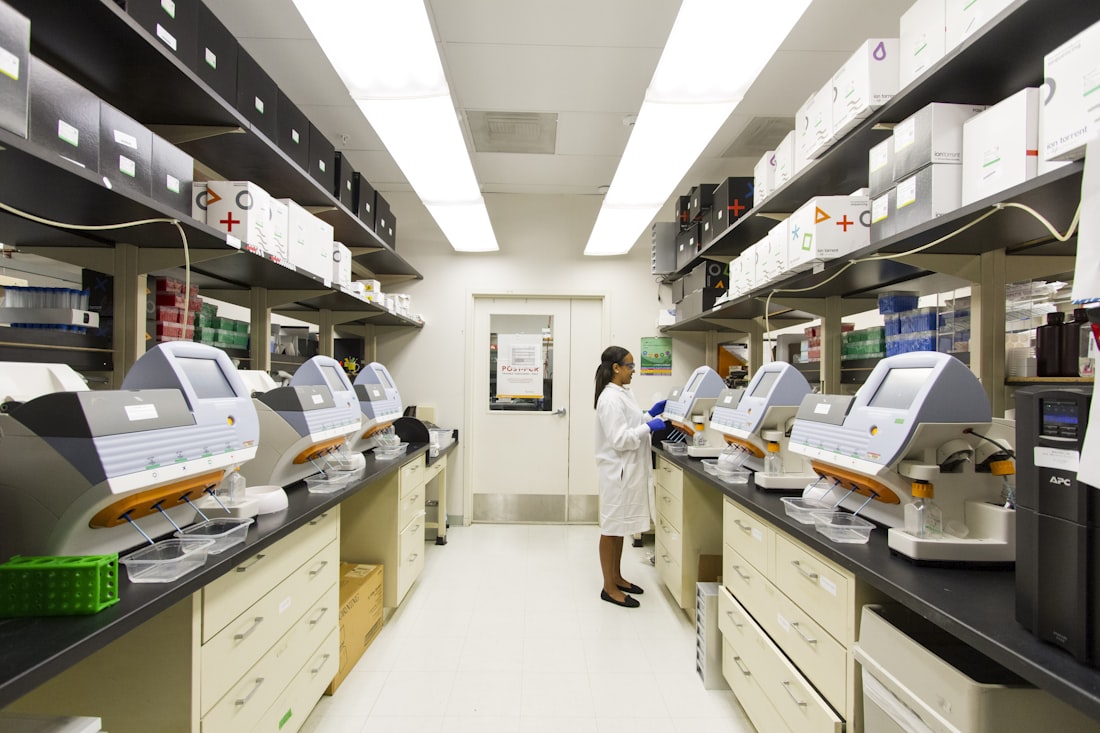
Isomorphic Labs has taken AI-designed drug candidates into actual human clinical trials.
Isomorphic Labs was founded in 2021 as a spin-off from Google DeepMind, with a stated mission to "reimagine and accelerate drug discovery." It has built what it calls a unified AI drug design engine, integrating AlphaFold-derived structural prediction with generative chemistry models that propose entirely new candidate molecules rather than just screening existing ones. The company has struck drug-design partnerships with major pharmaceutical companies, including Eli Lilly and Novartis, tasked with using AlphaFold-based technology to discover small molecules for specific, undisclosed drug targets.
In 2026, Isomorphic disclosed that AI-designed candidates, developed using AlphaFold 3 and its proprietary models, have entered human clinical trials, focused primarily on oncology and immunology. That milestone matters because it moves the story from "AI helps scientists work faster" to "a molecule an AI meaningfully helped design is now being tested in actual patients," a distinction worth taking seriously rather than treating every AI drug discovery headline as equally advanced.
Who Else Is Doing This, and How?
| Company or approach | Method | Notable detail |
|---|---|---|
| Isomorphic Labs | AlphaFold-based structural prediction plus generative chemistry | $2.1 billion Series B; partnerships with Eli Lilly and Novartis |
| Recursion Pharmaceuticals | AI combined with high-throughput automated lab screening | Has advanced multiple AI-curated candidates into clinical trials |
| A DDR1 kinase inhibitor (2019) | One of the earliest AI-generated drug candidates to enter trials | Entered clinical trials in 2021 as an early proof of concept for the field |
| Traditional pharma R&D teams | Increasingly layering AI tools onto existing discovery pipelines | A blend approach, not a replacement of established methods |
Notice the range of maturity across this table. Some approaches remain purely computational research. Others, like Isomorphic's oncology and immunology candidates, have reached actual human trials. Treating "AI drug discovery" as one uniform stage of development undersells how much variation exists within the category.
What Actually Happens Inside a Generative Chemistry Model?
Once AlphaFold-style structural prediction tells researchers the shape of a target protein, a separate generative model proposes candidate molecules likely to bind that specific shape, functioning conceptually similarly to how an image-generation model proposes pixels matching a description, except here the output has to obey the actual physical and chemical rules of real molecules, bond angles, atomic valences, and known reactive chemistry, not just look plausible.
This is a meaningfully harder generative problem than image or text generation, because a chemically invalid molecule is not just aesthetically wrong, it is literally impossible to synthesize in a lab. Much of the engineering effort in this specific field goes into constraining generative models so their outputs are not just creative, but genuinely synthesizable and testable by a real chemistry team.
Which Specific Steps Does AI Speed Up?
AI narrows an almost unimaginably large search space down to a shortlist a human chemist can actually test.
Target identification
Understanding which protein or biological pathway to target for a given disease, informed by AI analysis of genomic and biological data.
Structure prediction
Determining the 3D shape of the target protein, AlphaFold's original breakthrough contribution.
Molecule generation
Proposing entirely new candidate molecules likely to bind the target, rather than only screening a pre-existing chemical library.
Predicting toxicity and interactions
Modeling how a candidate molecule might behave and interact with other biological systems before it is ever synthesized.
Reducing wet-lab dependence
Using AI simulation to reduce, though not eliminate, the number of physical lab experiments needed at early stages.
Notice what is missing from this list: AI does not currently replace the actual clinical trial process, where a candidate drug is tested in real patients for safety and effectiveness. Every accelerated discovery step described here still feeds into that same, unavoidably slow, and heavily regulated human testing pipeline.
What Can AI Not Do in Drug Discovery, at Least Not Yet?
AI cannot skip clinical trials, and it cannot guarantee a candidate molecule will actually work safely in humans, since biology remains far more complex than any current model fully captures. Even a molecule that AI predicts should bind its target perfectly can still fail in a real patient for reasons the model did not anticipate, an interaction with another biological system, an unexpected side effect, or simply a disease mechanism more complicated than the target model assumed.
Isomorphic Labs' own leadership has been candid about this framing. Jaderberg has described the ambition as shrinking the timeline for tackling the next "undruggable" disease target from a multi-decade slog to something merely difficult, not instant or guaranteed. That is a genuinely significant claim if it holds up, and a meaningfully more modest one than "AI invents cures."
What Does This Mean for the Future of Medicine?
If AI genuinely compresses drug discovery timelines even by a fraction of what its developers claim, the practical effect is more treatments reaching patients faster and, potentially, cheaper, especially for diseases considered too difficult or commercially unattractive to pursue with traditional methods alone. Isomorphic's stated ambition, in the words of DeepMind's Demis Hassabis, is one day being able to "solve all diseases," an aspirational statement worth reading as a direction, not a promised timeline.
For the closely related question of how AI is accelerating the research process around drug discovery, rather than the molecule design itself, see our guide on AI and medicine development and our broader AI-assisted research guide.
Does AI Actually Make Drug Development Cheaper, or Just Faster?
Both, in theory, though the two are related rather than independent. Since a large share of traditional drug development cost comes from lengthy timelines, staff hours, and the high failure rate of candidates that reach expensive later-stage trials only to fail, narrowing the initial candidate pool more accurately before expensive human trials begin should reduce overall cost even if the per-step AI tools themselves add expense.
Whether this plays out as dramatically as some industry projections suggest remains to be seen at scale, since the clearest proof point, an AI-originated drug actually reaching approval at meaningfully lower total cost than a comparable traditionally developed drug, has not yet fully played out publicly. The oncology and immunology candidates now in human trials from companies like Isomorphic Labs are the ones to watch for that eventual real-world comparison.
Frequently Asked Questions
Has an AI-designed drug actually reached patients?
AI-designed candidates from companies including Isomorphic Labs and Recursion Pharmaceuticals have entered human clinical trials, with Isomorphic's oncology and immunology candidates disclosed in 2026. No fully AI-designed drug has yet completed the full approval process and reached general patient use.
What is AlphaFold and why does it matter for drug discovery?
AlphaFold is Google DeepMind's AI system that predicts the 3D structure of proteins from their genetic sequence, solving a decades-old scientific challenge. Knowing a protein's shape is essential for designing a drug molecule that can bind and affect it.
Does AI replace human scientists in drug discovery?
No. AI narrows an enormous search space and speeds up specific steps like structure prediction and molecule generation, but human scientists still design experiments, run clinical trials, and make the final judgment calls throughout the process.
How much does AI actually speed up drug discovery?
Public claims vary and are still being validated at scale, but the traditional pipeline of over 10 years and roughly $2.6 billion per drug is the benchmark AI-driven approaches are being measured against, with some companies reporting timeline reductions of 30 to 50%.
More AI & Health Guides, Written Clearly
Browse our full library of AI and health explainers, updated as the tools and evidence change.
More from the creator
Explore two other projects from the same creator.